
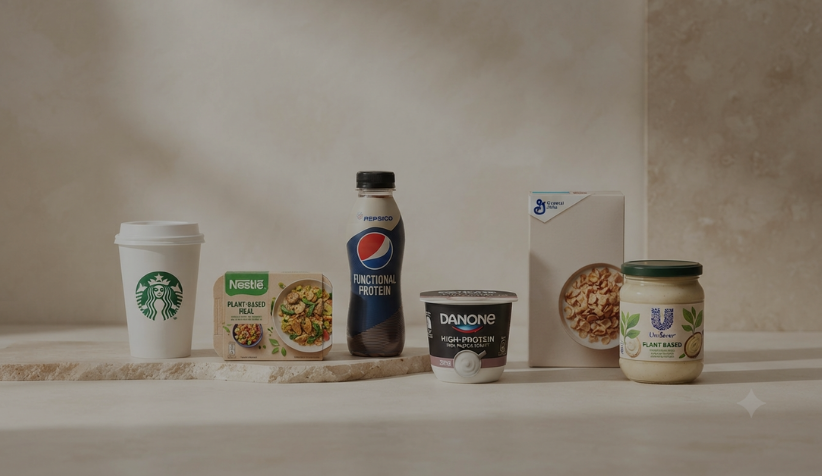
For years, choosing a protein ingredient was mostly a nutritional decision. How much protein does it provide? How much does it cost? Can we put it on the label?
That is changing.
As protein moves into everything from coffee and snacks to cereals and everyday foods, food manufacturers are asking a more complicated question: which protein actually works best in the product we’re trying to make?
That question matters because proteins are not interchangeable. They differ in amino acid composition, digestibility, solubility, texture, flavour, heat response, and the way they behave alongside the other ingredients in a formulation.
And as demand for protein continues to grow, the answer may increasingly depend on more than nutrition alone.
The Protein Question Is Getting More Complicated
Protein has become one of the defining nutritional preoccupations of the food industry. What was once largely the language of sports nutrition now appears across everyday foods, from breakfast cereals and snack bars to coffee and ready-to-drink beverages.
The numbers reflect that shift. In the 2025 International Food Information Council Food & Health Survey, 70% of Americans said they were trying to consume protein, making it the nutrient consumers were most likely to say they were actively seeking. Eight in ten said they had prioritised protein at least once during the day.¹
But the more interesting change is not simply that people want more protein. It is where manufacturers are now being asked to put it. Coffee is a particularly revealing example.
In September 2025, Starbucks introduced Protein Lattes and Protein Cold Foam across its U.S. and Canadian stores, with beverages providing approximately 15 to 36 grams of protein depending on the product and size. The company uses whey protein isolate in its protein-boosted milk and cold foam.²
At first glance, this is simply another high-protein product. Look more closely, and it illustrates a much larger formulation problem. A coffee still has to taste like coffee. A cold foam still has to behave like cold foam. The milk still has to retain the texture consumers expect from milk.
And somewhere inside all of that, the protein has to perform its part without compromising the rest. This is where the familiar question, “how much protein?”, begins to feel rather incomplete.
The more useful question is one food manufacturers are increasingly having to ask: “What does this particular protein need to do?”
Why Whey Became the Default
There is a reason whey protein appears so frequently in high-protein foods.
Whey provides all nine indispensable amino acids and has a long-established history in both nutrition and food formulation. Research comparing protein sources has also shown that different proteins can produce different post-meal amino acid responses, even when consumed at the same protein dose.³
But whey’s position is not explained by nutrition alone. It is familiar to formulators. Its functional behaviour has been extensively studied, and its use across beverages, bars and sports nutrition is well established. Decades of formulation experience also mean manufacturers understand how to work with it.
Starbucks offers a useful example.
Its current protein beverages use whey protein isolate, with sunflower lecithin included to support dispersion in the drink. Starbucks describes its protein-boosted milk as providing a smooth texture alongside approximately 12-16 additional grams of protein in a grande beverage, depending on the drink.² ⁴
There is a broader lesson here: An ingredient does not earn its place in a formulation through nutrition alone. It has to behave predictably, integrate with the product around it, and deliver the characteristics the formulation requires. The protein has to work inside the food.
When Protein Becomes a Formulation Problem
This is where the question becomes rather more interesting for food manufacturers.
ADM’s food scientists have described protein reformulation as a balance between quality, cost and functionality, with dairy, soy and pea proteins each being considered according to the requirements of the finished product.⁵
The principle itself is hardly new. What is changing is the extent to which it now matters. A protein ingredient does not exist in isolation once it enters a formulation. It can influence the texture of a bar, the viscosity of a beverage, the structure of an extruded snack, the stability of an emulsion and the way a product responds to heat. Which makes protein substitution considerably less straightforward than replacing one line on an ingredient statement with another.
A different protein may require a different inclusion level. It may interact with water differently, respond differently to processing, or introduce changes in texture, appearance or flavour. Those effects can, in turn, alter how the rest of the formulation behaves.
This is why two ingredients can look remarkably similar on a nutrition panel and behave quite differently in production. The label tells you how much protein is there. The formulation has to contend with what that protein actually does.
What Makes Mung Bean Protein Interesting
This is where mung bean protein powder becomes worth examining more closely.
Mung bean protein has a particular set of functional properties that researchers have been investigating across different food systems, from its interaction with water and oil to its behaviour under heat and its ability to form and stabilise structures.
A 2024 review of mung bean protein isolate describes properties including water and oil absorption, solubility, emulsification, foaming and thermal behaviour. But the more important observation is that these properties are not fixed. They can be influenced by how the protein is extracted, processed and subsequently handled.⁶
That distinction is easily overlooked. There is no single performance profile that can simply be called “mung bean protein”. An isolate is the result of a particular raw material, production process and set of processing conditions, and those variables can ultimately shape how the ingredient behaves in a formulation.
More recent research makes the point rather neatly.
A 2026 study published in Food Chemistry compared mung bean protein isolates produced using isoelectric precipitation and ultrafiltration-diafiltration. Both isolates contained approximately 84% protein, yet they differed in structure and techno-functional behaviour. One produced greater gel firmness, while the other demonstrated greater foam stability. The researchers therefore concluded that the production method should be considered in relation to the intended food application.⁷
The implication is rather more interesting than the numbers themselves. The same crop can produce protein ingredients with meaningfully different functional characteristics. And for a formulator, protein content is only the beginning of the conversation.
What matters is how that protein behaves once it enters the system: how it interacts with water, how it responds to processing, and whether its particular functional properties suit the structure the finished product is trying to achieve.
The Protein Source Is Only Part of the Ingredient
It is tempting to think of a protein ingredient as a number: 80% protein. 85%. 90%.
The figure is useful, certainly. But it tells only part of the story.
Protein content describes what an ingredient contains. It does not, by itself, tell a formulator how that ingredient will behave once it enters a food system. That behaviour can be shaped long before the ingredient reaches the production line. Extraction can alter protein structure. Drying can influence its physical properties. Heat can change the way proteins unfold and interact. And conditions within the finished product, including pH and moisture, can further influence how the ingredient behaves.
Research on mung bean protein isolate demonstrates this quite clearly. Different drying methods have been shown to produce differences in the morphology, rheological behaviour and functional properties of mung bean protein isolate powders.⁸ Another study found that altering moisture conditions during extrusion changed the structural and functional characteristics of mung bean protein.⁹
These findings point towards a distinction that is rather important for ingredient selection: the crop is not the specification. A mung bean protein is not fully described by its botanical source or its protein percentage. It is a processed material whose eventual performance reflects how it was produced, how it was handled and the conditions in which it is asked to perform.
For a mung bean protein supplier, that means a useful technical specification needs to extend well beyond a single number on a certificate of analysis. And for a formulator, the more useful question is ultimately a practical one:
What will this ingredient actually do once it enters the formulation?
Nutrition Still Matters
Functionality is only half of the equation.
A protein ingredient can behave beautifully in a formulation, but it still has to deliver nutritionally. For all the attention now given to texture, solubility and processing behaviour, the reason protein is being added in the first place remains nutritional.
Mung bean protein contains all nine indispensable amino acids, with lysine being present at relatively high levels compared with many cereal proteins. Reviews of mung bean protein have also highlighted its nutritional potential alongside its functional characteristics.⁶ ¹¹
But protein quality is not a single number that can be permanently assigned to a crop. It depends on what is being measured, which material is being tested, how that material has been processed, and which method has been used to assess its nutritional quality.
This is particularly important when interpreting measures such as DIAAS. A value reported for a whole cooked mung bean should not automatically be taken as representative of a purified mung bean protein isolate.
They are different materials. The distinction matters because processing can alter the composition and structure of a protein ingredient, while the method used to assess digestibility and amino acid availability can also influence the result.
The same caution applies when comparing published studies. Differences in the raw material, processing conditions, experimental model, reference amino acid pattern and method of measuring digestibility can all contribute to different reported outcomes.
That does not necessarily make the literature contradictory. It means the question needs to be more precisely framed, “Which protein material was tested, under which conditions, and measured by which method”
For anyone evaluating a mung bean protein powder, that is a considerably more useful question than searching for a single number that is supposed to tell the whole story.
The Ingredient Has to Earn Its Place
This may be one of the more important shifts taking place in protein formulation.
For a long time, the central question was relatively straightforward: How do we add more protein?
Increasingly, that question feels incomplete. The more useful question is: What should the protein actually do here?
A beverage may require rapid dispersion, stability and an acceptable mouthfeel. A bar may place very different demands on an ingredient, particularly when working within a low-moisture matrix. A savoury product may require the protein to contribute to structure, water management or emulsification. An extruded snack, meanwhile, introduces an entirely different set of conditions, where heat, pressure and moisture can influence the behaviour of the ingredient.
The nutritional target may be identical across all four products. The ingredient decision need not be. This is why the next chapter of plant protein is unlikely to be determined simply by comparing protein percentages on specification sheets. A higher percentage may tell you something about composition, but it does not tell you whether the ingredient is suited to the process, the matrix or the finished product.
For formulators, that distinction is increasingly important. The question is no longer simply how much protein an ingredient contains. It is whether the ingredient earns its place in the formulation. Because ultimately, that is where protein stops being a number on a specification sheet and starts becoming an ingredient.
The Next Protein Question
The protein market is expanding, but the more consequential change may be taking place at a rather more technical level. The question is gradually moving away from which protein is best and towards a more useful one: “Which protein is appropriate for the formulation in front of us?”
Whey will continue to be valuable where its nutritional, sensory and functional characteristics suit the product. Soy and pea have established roles across plant-based food development. Mung bean protein need not displace either. Its relevance will depend on whether its particular properties solve a problem that the formulation is trying to solve.
That is a more sensible way to think about ingredient innovation. A protein should be considered not simply by its percentage, but by the relationship between its composition, processing history, functional behaviour and the conditions under which it is ultimately used. The same ingredient can be unremarkable in one system and rather useful in another.
This is where mung bean protein warrants closer attention. Its nutritional characteristics are well documented, while research into mung bean protein isolates continues to reveal useful differences in solubility, emulsification, foaming, gelation and thermal behaviour. Just as importantly, those properties are influenced by how the isolate is produced.⁶ ⁷
The future of plant protein is unlikely to be determined by finding a single ingredient that performs every function better than everything that came before it. Food is too varied, and formulation is too dependent on context, for that proposition to be particularly useful.
The more interesting prospect is a broader and more precise ingredient palette, in which proteins are selected according to what they can contribute to a particular food.
And that may be the real opportunity for mung bean protein.
Not to be the answer to protein formulation, but to become an increasingly well-understood answer to some of its more difficult questions. For formulators, that is perhaps the question worth pursuing next: not how much protein can be added, but what the right protein can make possible.
As protein-enriched foods move into an increasingly diverse range of formats, selecting a protein is becoming a more considered formulation decision. Nutritional composition, processing history, functionality, inclusion level and performance in the finished product all have a bearing on whether an ingredient is genuinely suited to the application.
At OMN9, we work with food manufacturers to develop Mung Bean Protein Isolate 80%, with a focus on understanding how its nutritional and functional properties can translate across different food systems. Our approach is grounded in the ingredient itself: how it is produced, how it behaves, and where its particular characteristics can be useful.
Connect with us to explore mung bean protein for your next formulation, and look beyond the protein percentage to what the ingredient can actually contribute.
1. International Food Information Council (IFIC). (2025). 2025 IFIC Food & Health Survey. International Food Information Council. https://ific.org/research/2025-food-health-survey/
2. Starbucks Coffee Company. (2025). Starbucks Goes all in on Protein: Announces Arrival of New Protein Lattes and Protein Cold Foam to the Menu on Sept. 29. Starbucks Coffee Company. https://about.starbucks.com/press/2025/starbucks-goes-all-in-on-protein-announces-arrival-of-new-protein-lattes-and-protein-cold-foam-to-the-menu/
3. van Vliet, S., Burd, N. A., & van Loon, L. J. C. (2015). The skeletal muscle anabolic response to plant- versus animal-based protein consumption. Journal of Nutrition. https://doi.org/10.3945/jn.114.204305
4. Starbucks Coffee Company. (2025). Starbucks Protein Lattes and Protein Cold Foam. Starbucks Coffee Company. https://protein.starbucks.com/
5. ADM. (2026). Protein and food formulation: balancing nutrition, cost and functionality. ADM. https://www.adm.com/
6. Tarahi, M., Abdolalizadeh, L., & Hedayati, S. (2024). Mung bean protein isolate: Extraction, structure, physicochemical properties, modifications, and food applications. Food Chemistry, 444, 138626. https://doi.org/10.1016/j.foodchem.2024.138626
7. (2026). Production of mung bean protein isolates by isoelectric precipitation and ultrafiltration-diafiltration: Impact on the composition, structural and techno-functional properties as well as in vitro digestibility. Food Chemistry, 149560. https://doi.org/10.1016/j.foodchem.2026.149560
8. Brishti, F. H., Chay, S. Y., Muhammad, K., Ismail-Fitry, M. R., Zarei, M., Karthikeyan, S., & Saari, N. (2020). Effects of drying techniques on the physicochemical, functional, thermal, structural and rheological properties of mung bean (Vigna radiata) protein isolate powder. Food Research International, 138, 109783. https://doi.org/10.1016/j.foodres.2020.109783
9. Brishti, F. H., Chay, S. Y., Muhammad, K., Ismail-Fitry, M. R., Zarei, M., Karthikeyan, S., Caballero-Briones, F., & Saari, N. (2021). Structural and rheological changes of texturized mung bean protein induced by feed moisture during extrusion. Food Chemistry, 344, 128643. https://doi.org/10.1016/j.foodchem.2020.128643
10. Tang, C.-H. (2017). Functional properties and food applications of legume proteins: A review. Food Hydrocolloids. https://doi.org/10.1016/j.foodhyd.2016.12.012
11. Tang, C.-H. (2017). Mung bean proteins and peptides: Nutritional, functional and bioactive properties. Food Research International. https://doi.org/10.1016/j.foodres.2017.11.031

Innovating the ideal protein from plants
E-19, Agro Food Park, Boranda, Jodhpur 342012
Pusa Krishi, IARI Pusa Campus, Delhi 110012
Phone: +91 291 2979350
Email: info@omn9.com