
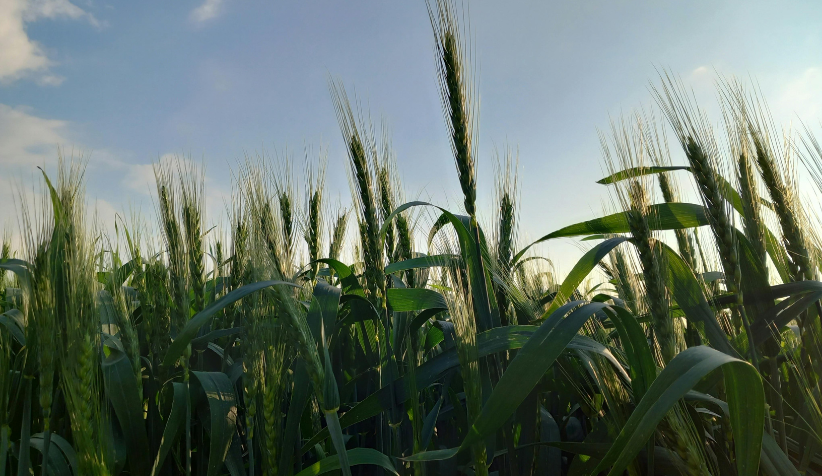
Most conversations about climate change and agriculture start with a version of the same question: will we be able to grow enough food? It’s the right question to ask about drought, heat, and shrinking arable land. But it isn’t the only question worth asking. A second one is less intuitive but increasingly the subject of serious research.
What if the food we grow doesn’t just change in quantity, but changes in composition?
Specifically: what if rising atmospheric CO₂ can reduce the protein concentration of some staple crops, even under conditions where elevated CO₂ stimulates plant growth or yield?
That question turns out to have a real, evidence-backed answer and a more interesting second layer once you ask why it doesn’t happen the same way in every crop.
Growth and Nutrition Are Not Always the Same
Plants need carbon dioxide for photosynthesis. For many of the world’s major crops, including wheat, rice, soybean, and many legumes, elevated CO₂ can stimulate photosynthesis and, under suitable growing conditions, increase biomass or yield.
The intuitive next step is to assume that more growth means more of everything, protein included. That assumption does not always hold. While elevated CO₂ can increase carbon assimilation, protein synthesis also depends on the plant’s ability to acquire and assimilate sufficient nitrogen.
A plant’s proteins are synthesized using nitrogen that the plant acquires and assimilates, primarily from the soil or, in the case of nitrogen-fixing legumes, partly through symbiotic fixation of atmospheric nitrogen. If carbon gain increases without a proportional increase in nitrogen acquisition and assimilation, the balance between carbon-rich and nitrogen-containing compounds can shift. In a number of major crops, elevated CO₂ has been associated with a measurable decline in grain protein concentration.
Free-Air CO₂ Enrichment (FACE) experiments allow researchers to study how crops respond to elevated CO₂ under open-field conditions, rather than inside enclosed chambers. Using this approach and other experimental systems, researchers have repeatedly observed changes in the nutritional composition of major food crops.
Elevated CO₂ has been associated with lower protein concentrations in important staple crops, including wheat and rice. A 2025 review summarising the available literature notes that wheat grown under elevated CO₂ has, in some studies, shown protein reductions of up to 65%, while declines of over 50% in zinc and iron concentrations have been reported in rice and other staple crops. These represent reported observations within the literature rather than typical or universal responses, and the magnitude of nutritional changes varies substantially by crop, cultivar, nutrient, and growing conditions.
The mechanism is often described as a “dilution effect,” though that label oversimplifies the biology involved. Increased carbon assimilation can dilute nitrogen-containing compounds, while elevated CO₂ may also alter nitrogen uptake, transpiration-driven nutrient supply, and nutrient allocation within the plant. The relative contribution of these mechanisms can vary across species and growing conditions.
For countries where cereals provide a significant share of daily protein intake, this is more than an agricultural concern. It can become a question of nutritional quality. “Nearly half of India’s at-home protein intake now comes from cereals such as rice, wheat, suji, and maida.”
Different Crops Respond Differently
Here is where the story becomes more interesting than a simple “CO₂ lowers protein” headline would suggest. Not every crop acquires nitrogen in the same way, and that difference can influence how plants respond when atmospheric CO₂ changes.
Non-leguminous crops, including major grain crops, rely primarily on nitrogen available in the soil, whether from natural soil processes or applied fertilisers. Because nitrogen is essential for the synthesis of amino acids and proteins, the availability and assimilation of nitrogen can influence the protein concentration of the harvested crop. Under elevated CO₂, increased carbon assimilation can alter the balance between carbon and nitrogen within the plant, particularly when nitrogen acquisition does not increase proportionally.
Legumes operate differently.
Many legumes can supplement their nitrogen requirements through a symbiotic relationship with nitrogen-fixing microorganisms. These microorganisms convert atmospheric nitrogen into forms that can be incorporated into plant metabolism, giving legumes an additional biological pathway for acquiring the nitrogen required to synthesise amino acids and proteins.
That does not mean legumes are unaffected by elevated CO₂, or that their protein concentration is automatically protected as growing conditions change. Nitrogen fixation itself depends on a range of biological and environmental factors, and the response of any crop can vary with species, genotype, nutrient availability, water, temperature, and other growing conditions.
But the distinction remains important.
Non-leguminous crops and nitrogen-fixing legumes do not rely on exactly the same pathways to acquire one of the essential elements required to build protein. That difference in nitrogen biology is one reason crop responses to elevated CO₂ should not be treated as universal.
To understand why, it helps to look more closely at where a plant’s nitrogen actually comes from.
Nitrogen Changes the Equation
Nitrogen makes up approximately 78% of Earth’s atmosphere. However, plants cannot directly use atmospheric nitrogen in its predominant molecular form, N₂. Before it can enter plant metabolism, nitrogen must first be converted into chemically reactive forms.
Wheat, rice, and other non-leguminous crops acquire nitrogen primarily in mineral forms from the soil. These forms can originate from the mineralisation of soil organic matter, biological transformations within the soil, or the application of nitrogen-containing fertilisers.
Many legumes have an additional pathway, and it is a genuinely elegant piece of biology. In compatible associations, legume plants form symbiotic relationships with bacteria collectively known as rhizobia. This interaction can lead to the formation of specialised root structures called nodules, within which symbiotic nitrogen fixation takes place.
Within these nodules, nitrogenase produced by the bacterial symbionts catalyses the reduction of atmospheric N₂ to ammonia. The resulting fixed nitrogen is subsequently assimilated into organic nitrogen compounds and can contribute to the synthesis of amino acids and proteins. In return, the plant supplies the symbiotic bacteria with reduced carbon compounds derived from photosynthesis, helping meet the substantial energy requirements of nitrogen fixation.
This process, known as biological nitrogen fixation, does not make legumes independent of their growing environment. The establishment and effectiveness of the legume–rhizobia symbiosis can be influenced by nutrient availability, including phosphorus and essential micronutrients, as well as water availability, temperature, soil conditions, plant genotype, and compatibility between the plant and its microbial partner.
But for legumes capable of establishing an effective nitrogen-fixing symbiosis, it provides an additional biological pathway for acquiring nitrogen alongside uptake of mineral nitrogen from the soil, a pathway that wheat and rice do not possess.
A Different Relationship With Nitrogen
This is where the two threads of the story connect, and it is also where the evidence needs to be handled carefully.
Legumes have a fundamentally different relationship with nitrogen. Biological nitrogen fixation is an energy-intensive process, and the symbiotic bacteria responsible for fixation depend on carbon compounds supplied by the host plant. This raises an important question: if elevated CO₂ increases photosynthesis and carbon assimilation in a responsive legume, could that additional carbon support nitrogen fixation under suitable conditions?
The answer is not universal, but the underlying mechanism is biologically plausible. The response depends on the plant, its microbial partner, and the conditions in which the symbiosis is operating.
Research on elevated CO₂ and legumes supports a more nuanced explanation than a single universal outcome. The response of nitrogen fixation depends on whether the conditions required to support plant growth and the legume-rhizobia symbiosis are present. Rogers, Ainsworth and Leakey specifically describe this conditional relationship: “In C₃ plants, elevated [CO₂] increases photosynthesis and decreases stomatal conductance. In the absence of other nutrient limitations, legumes will be able to capitalize on the benefits of elevated [CO₂] by both increasing N₂ fixation and by reducing the negative impact of drought on N₂ fixation.”
This distinction matters. Elevated CO₂ does not automatically increase nitrogen fixation in every legume or under every growing condition. Nutrient limitations, temperature, drought and other constraints on plant growth can limit the extent to which a legume can translate additional carbon assimilation into increased nitrogen fixation. The evidence therefore does not support treating experimental responses to elevated CO₂ as universal predictions of how every legume will respond under future field conditions.
These differences offer one biologically grounded explanation for why nitrogen-fixing legumes may respond differently to elevated CO₂ than non-leguminous crops. The distinction is not that legumes are inherently immune to climate stress. Rather, legumes capable of effective symbiotic nitrogen fixation possess an additional pathway for acquiring nitrogen; a pathway that non-leguminous cereals such as wheat and rice do not have.
The more accurate conclusion, then, is not “legumes are more climate-resilient.” It is narrower and more scientifically defensible: because nitrogen-fixing legumes can couple carbon supplied by the host plant with symbiotic nitrogen fixation, elevated CO₂ can, under suitable conditions, influence their nitrogen economy differently from that of non-leguminous crops.
What This Means for Mung Bean
Mung bean (Vigna radiata) belongs to this same category of nodulating, nitrogen-fixing legumes, which is what makes it relevant to this discussion in the first place.
Research on mung bean grown under elevated CO₂ has documented changes in nutrient dynamics and nodulation. In a Free-Air CO₂ Enrichment experiment conducted at 550 ± 19 μmol mol⁻¹ CO₂, elevated CO₂ significantly increased nodule weight per plant at the flowering and pod stages. At maturity, whole-plant nitrogen concentration was 4.4% lower under elevated CO₂, while phosphorus and potassium concentrations were unchanged. The study also found no significant effect on nitrogen, phosphorus, or potassium-use efficiency in the seed.
That’s a genuine and useful data point about how mung bean responds to a CO₂-enriched environment.
What it is not, on its own, is evidence about what happens to protein concentration in the harvested seed. Increased nodule mass is not a direct measurement of nitrogen fixation, and neither increased nodulation nor changes in whole-plant nitrogen concentration can be treated as evidence that seed protein will remain stable under elevated CO₂.
The available evidence therefore does not establish how, or whether, these upstream responses translate into stable seed protein concentration as atmospheric CO₂ rises. What can be said, accurately, is narrower: mung bean belongs to a crop group with a nitrogen-acquisition pathway that differs meaningfully from non-leguminous cereals, and experimental evidence shows that its nodulation and nutrient dynamics can respond to elevated CO₂.
That’s a reasonable basis for further research, not yet a conclusion about its future protein content.
That’s a more honest position than either extreme. It’s also, on reflection, a more interesting one, because it points toward a question the ingredient industry hasn’t spent much time asking.
Ingredient Quality Begins Before Processing
Plant protein innovation has, for the most part, focused on what happens after the crop is harvested. Extraction method. Isolation. Fractionation. How a protein behaves once it’s asked to solubilize, emulsify, foam, or gel inside a finished product. These questions are not going away, and they remain central to whether an ingredient actually performs in a formulation.
But there’s a question sitting upstream of all of them: what is the biological starting material, and how stable is its composition likely to be as growing conditions shift?
A protein isolate’s composition and functionality are influenced both by the characteristics of the starting material and by the extraction and processing methods used to produce it. If the nutritional composition of raw crops changes under different growing conditions, as elevated CO₂ studies have shown can occur in some staples, those crop-level differences may become relevant to the ingredient supply chain. How strongly they influence a finished protein isolate will depend on the crop, the magnitude of the compositional change, and the processing system itself.
Why Crop Diversity Matters
None of this points toward a single “future-proof” crop, and the evidence doesn’t support that kind of claim for mung bean, soybean, or anything else.
What it does point toward is a more modest and more defensible idea: different crops have different physiological pathways for acquiring and using nutrients, and those differences can influence how they respond to changes in CO₂, water availability, temperature, and nutrient supply.
Cereals acquire most of their nitrogen from soil-derived sources. Nitrogen-fixing legumes can obtain part of their nitrogen through symbiotic fixation, but that pathway has its own set of dependencies and limitations. Neither system is inherently more secure, they are biologically different and may respond differently to environmental pressures.
A portfolio that includes crops with different physiological characteristics is not insulated from climate variability, and the available evidence does not allow us to quantify how much diversification would reduce supply risk in any particular protein system. But diversification can reduce dependence on a single crop or crop type and may be one consideration when evaluating exposure to agricultural variability.
For formulators and procurement teams, this suggests a criterion that hasn’t traditionally been on the ingredient scorecard alongside amino acid profile, solubility, cost, and sensory performance: what biological and environmental factors influence the composition of the crop from which this ingredient is produced, and how sensitive are those factors to changing growing conditions?
It won’t replace the existing criteria. It’s a layer underneath them.
The Future of Protein Starts With the Crop
The research on CO₂ and crop protein does not offer a tidy conclusion, and it should not be forced into one. Elevated CO₂ has been associated with lower protein concentrations in important staple crops, including wheat and rice. Research has also documented changes in the concentrations of other nutrients under elevated CO₂, although the direction and magnitude of those changes can vary by crop, cultivar, nutrient, and growing conditions.
Legumes should not be treated as a single exception to this pattern. Their responses to elevated CO₂ can also vary depending on species and growing conditions. What distinguishes nitrogen-fixing legumes is not immunity from environmental change, but the presence of a biological pathway for acquiring nitrogen through symbiotic fixation when an effective plant–microbe association is established.
Mung bean belongs to this group of legumes. Research has examined how elevated CO₂ can influence aspects of its growth and nitrogen-fixation biology, including nodulation. However, these responses should not be interpreted as direct evidence of how protein concentration in harvested mung bean seed will respond under future elevated-CO₂ conditions.
What connects all of it is a more fundamental point about where ingredient science actually begins. The performance of a protein isolate is usually described in terms of what happens to it in a lab or on a production line; how it is extracted, modified, and formulated. But before any of that, the protein itself had to be synthesised by the crop using nitrogen acquired through soil uptake and, in nitrogen-fixing legumes, potentially through symbiotic biological nitrogen fixation.
Understanding that part of the story, the biology of the crop before it ever reaches a processing facility, is relevant to understanding how agricultural conditions can influence the raw materials from which food ingredients are produced.
At OMN9, this is part of what shapes how we think about ingredient development: not only how a protein performs once it is isolated, but also the biological system that produced it in the first place. Our work with mung bean protein sits within that broader question, not as a claim that any single crop has solved the challenges created by changing growing conditions, but as part of a wider effort to understand how crop biology, nitrogen availability, and ingredient science connect.
← Protein Supply Chain Resilience Why More Protein Doesn’t Always Mean Better Nutrition →
As climate conditions continue to influence crop growth, nutrition, and agricultural systems, building more resilient protein supply chains will require looking beyond yield alone. Understanding crop biology, nitrogen availability, and the way different crops respond to environmental change can help inform how we approach the next generation of protein ingredients. At OMN9, we work with food manufacturers to advance Mung Bean Protein Isolate 80%, exploring how crop biology and ingredient science can come together to develop scalable, functional protein solutions for the future of food.
Connect with us to explore how mung bean protein can support your next plant-based formulation while diversifying the biological foundations of your protein supply chain.

Innovating the ideal protein from plants
E-19, Agro Food Park, Boranda, Jodhpur 342012
Pusa Krishi, IARI Pusa Campus, Delhi 110012
Phone: +91 291 2979350
Email: info@omn9.com